
What your chances really mean
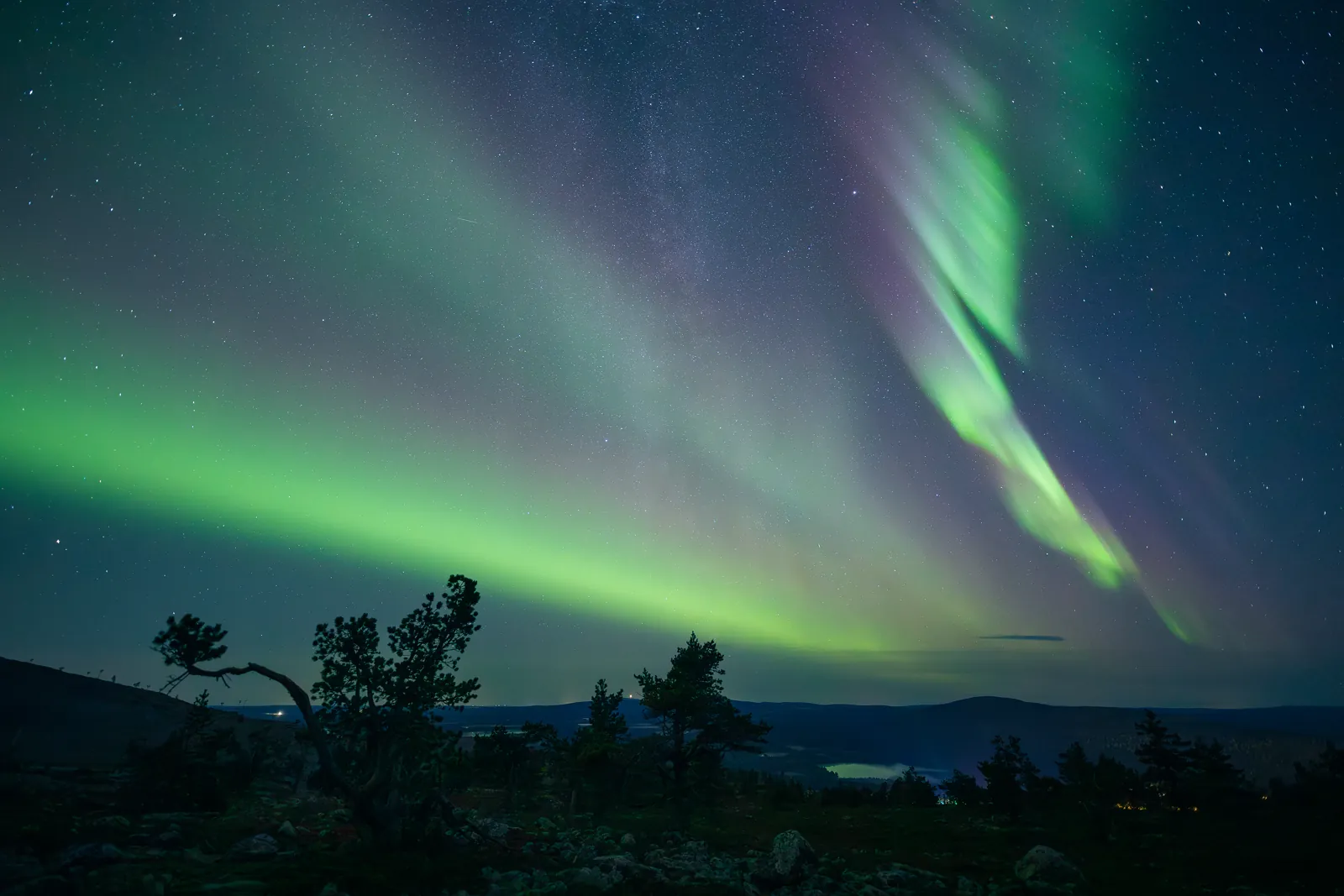
Two things have to come together above your viewing spot: aurora activity and a view of it.
Cloud can hide a display, and bright summer nights prevent the darkness needed to see it.
The Finnish Meteorological Institute distinguishes statistics gathered over many years from short-term forecasts.
That distinction matters when a holiday advert gives a striking percentage.
A regional average is background information, not the chance assigned to your family’s particular evening outside a hotel.
Treat it as a reason to choose a region, rather than a promise about a booking.
Visit Finland describes the lights as appearing on roughly every other clear night in Lapland during the season.
The important word is clear: it does not mean half of all holiday nights regardless of cloud.
Latitude and exact location matter too, so do not turn the figure into a neat calculation for a three-night stay.
Your best response to uncertainty is practical.
Stay longer if possible, look on more than one evening and book daytime activities you genuinely want.
That makes seeing the lights a wonderful part of a good holiday rather than the test the whole trip must pass.
Best months: Christmas is not the only answer
Visit Finland’s 2026 guide gives the broad Finnish aurora-viewing season as late August to early April, with September–October and February–March highlighted for activity. Those shoulder periods deserve attention if the sky is the main reason for travelling. Autumn offers dark nights without requiring a Christmas itinerary. Late winter combines aurora opportunities with a snow holiday and more daylight for the daytime plans. Choose the season for the complete experience you want, then check the actual weather and activities available at your destination.
Those shoulder periods deserve attention if the sky is the main reason for travelling.
Autumn offers dark nights without requiring a Christmas itinerary.
Late winter combines aurora opportunities with a snow holiday and more daylight for the daytime plans.
Choose the season for the complete experience you want, then check the actual weather and activities available at your destination.
December and January have their own appeal:
long, dark evenings and the atmosphere families associate with a snowy Santa holiday.
Darkness creates viewing time, but it does not clear the clouds or command a display.
If you have fixed school-holiday dates, there is no need to treat them as a mistake.
Build a balanced itinerary and keep an evening or two free.
If you can choose freely and do not need Santa before Christmas, compare a late-winter trip as well. Our Santa planning guide
Choose a destination for more than a forecast
The Finnish Meteorological Institute explains that aurora frequency changes with latitude.
That gives a good reason to consider northern resorts, but access, accommodation and the shape of the holiday still matter.
A remote location is not automatically the best choice for a family that needs easy meals, short transfers or reliable indoor breaks.
Start by choosing a destination you can enjoy by day, then identify sensible dark places or guided outings nearby.
The destination hub compares the character of the Finnish resorts, Swedish Lapland and Tromsø.
Rovaniemi is a practical choice when Santa is the priority and auroras are a bonus.
A resort such as Saariselkä may appeal to a family wanting a different balance of winter activities and evenings outdoors.
These are editorial choices about the holiday, not rankings of guaranteed sightings.
Read the destination pages for travel and access details, then ask accommodation providers where guests can safely watch the sky.
The ideal arrangement is one you can use repeatedly without a complicated journey every time the clouds briefly break.
A comfortable base can be more useful than an ambitious nightly expedition.
Read the weather forecast and the space-weather forecast
Use two separate checks.
The ordinary weather forecast tells you about cloud and local conditions;
the space-weather service indicates aurora activity.
The Finnish Meteorological Institute’s live serviceIts yellow and red markers indicate different activity thresholds.
Those colours are not a guarantee of a visible show through cloud.
Read the explanation on the official page rather than relying on a screenshot of a forecast app stripped of its location and time.
Look at the local forecast again during the afternoon, then decide how much energy to spend on the evening.
An alert should be an invitation to look, not a reason to abandon common sense or keep an exhausted child outside.
Avoid planning the whole trip around a long-range prediction made weeks in advance.
The closer you are to the evening, the more useful the live information becomes, but uncertainty remains.
Ask a local guide what the conditions mean for the outing you have booked and whether there is an alternative plan when the sky is covered.
Pick the right place to stand
A dark, open view is useful; a safe, accessible one is essential. Visit Finland recommends getting away from artificial light and choosing open ground. Translate that into a realistic plan from your accommodation: a recognised viewing area, a route described by the provider or a guided excursion. An inviting shape on a map is not permission to cross private land or walk onto ice. Use local advice, respect signs and choose a place where you know how to return to warmth without difficulty.
Translate that into a realistic plan from your accommodation:
a recognised viewing area, a route described by the provider or a guided excursion.
An inviting shape on a map is not permission to cross private land or walk onto ice.
Use local advice, respect signs and choose a place where you know how to return to warmth without difficulty.
Do not confuse an unobstructed view with a need to travel as far as possible.
For families, a nearby spot you can try several times may work better than one long journey.
Check the route in daylight if it is suitable to do so, ask about snow clearance and arrange transport before going out.
Keep any torches considerate of other watchers and avoid shining lights into people’s eyes or cameras.
If mobility is a concern, ask about the route surface, gradient, seating and access to an indoor space.
The word viewpoint alone does not answer those questions.
Is a guided aurora tour worth it?
A good guide offers local knowledge, transport and a plan for the conditions.
That can be valuable if you do not want to drive on unfamiliar winter roads or judge routes yourself.
Compare what the tour actually provides:
transport, time outdoors, loan clothing, food, toilets and the return arrangements.
Ask whether it is a fixed viewing session or a trip that may travel between locations.
Neither format can promise the sky will perform.
Choose the one that suits your party’s comfort and attention span, rather than the one with the boldest claim about the photographs you will take home.
For a young family, understand how late the outing finishes and whether children can rest somewhere warm.
The Finnish Meteorological Institute identifies the late evening and early hours as a useful viewing period, which is not naturally a toddler-friendly timetable.
You may prefer parents taking turns to look from near the accommodation, provided childcare and safety are properly arranged.
For older children who actively want the outing, talk through the possibility of seeing stars and snow rather than auroras.
That honest expectation makes the tour an adventure even if the hoped-for display does not arrive.
Glass roofs, photographs and expectations
A glass-roofed room is accommodation with a view, not a separate kind of aurora guarantee.
Decide whether you would enjoy the room on a cloudy night, then judge the price against the rest of the budget.
A comfortable ordinary room with access to a safe viewing spot can also make sense.
If a glass cabin is the treat you most want, keep it as a treat:
enjoy the setting and use the hotel’s advice on alerts.
Do not expect a room category to replace clear skies, darkness or time looking outside.
Photographs are another reason to keep expectations grounded.
Visit Finland notes that a phone’s night mode or a camera can capture more than the naked eye alone.
Promotional pictures therefore do not tell you exactly how a display will look to someone standing there.
Put looking first and taking pictures second.
Prepare the camera or phone before going out so that the first interesting moment is not spent searching settings.
Bring the equipment you already know how to use, keep personal safety ahead of a shot and let at least part of the evening belong simply to watching.
Keep the family warm and the holiday balanced
Waiting for a display is different from running around in snow.
Plan layers for time standing or sitting still, follow the guide’s clothing advice and make warm-up breaks easy. Our Lapland packing guide
Take tiredness seriously. Nobody needs to prove they can stay outside longest.
For a child, a brief look at a wonderful sky followed by a warm bed is a better memory than an exhausting wait that goes on until everyone is miserable.
Our preferred plan is a holiday with more than one possible viewing evening, a flexible schedule and worthwhile daytime plans.
Put the important Santa meeting, winter activity or museum visit into the itinerary, then leave space for the weather to influence your nights.
A flying Santa day tripWith several nights, you can look again; with one tightly scheduled day, you may never have the opportunity.
Book for Lapland, and let the northern lights be the extraordinary thing you hope to add.
Your questions answered
What is the best month for northern lights in Lapland?
There is no guaranteed month.
Visit Finland highlights September–October and February–March for aurora activity within a viewing season running from late August to early April.
Do three nights guarantee a sighting?
No.
Several nights provide more opportunities to look, but cloud and variable aurora activity can prevent a sighting throughout a stay.
Can we see auroras through cloud?
Thick cloud can hide the display.
Check both ordinary weather and space weather;
a strong activity forecast does not remove cloud cover.
Will a glass-roofed cabin guarantee the northern lights?
No. It provides a view of the sky, but visible auroras still require suitable darkness, weather and activity.
Should we take small children on a late tour?
Judge the actual tour duration, warm-up arrangements and your child’s routine.
A nearby viewing spot or a shorter outing may suit your family better.